
What if propulsion did not have to work the way it always has?
A different way to move through air and space
Does thrust always have to mean recoil?
Propeller, turbine, rocket: however different they look, they rest on the same idea — accelerate mass backwards to move forward. That limits range, payload and operating cost. TECLOW has developed a vision and a theoretical model in response. We present it openly as a concept, because it has not been demonstrated.
The idea
- 01A vision and a theoretical model, not a built device.
- 02The target field is described broadly: drones, jets and aircraft, and potentially rockets.
- 03The path forward runs through simulation and engineering validation before any demonstrator.
How it works
- The model describes force generation that does not rely on accelerating a carried propellant stream.
- Design therefore shifts away from fuel mass towards available electrical power.
- Before anything is built, calculation and simulation must show whether the assumed forces arise at a usable magnitude at all.
What is different about it
- No exhaust jet as the load-bearing principle.
- Fewer large moving parts than propeller or turbine propulsion.
- Scaling from drone to aircraft would conceptually use the same layout.
What we already have
- A formulated theoretical model and its derivation.
- A defined sequence of validation steps.
What we still want to prove
- Whether a usable, measurable thrust arises in the model at all.
- The ratio of electrical power input to generated force.
- Whether the behaviour transfers from laboratory scale to aircraft-relevant sizes.
Where it could matter
- Drones and unmanned flight
- Aircraft and jets
- Potentially rockets and space transport
Request more
information
Factsheets, technical documents and presentations on Innovative Propulsion are not public downloads. Tell us who you are and what you need, and we will share what is appropriate.
Continue
secureAIR
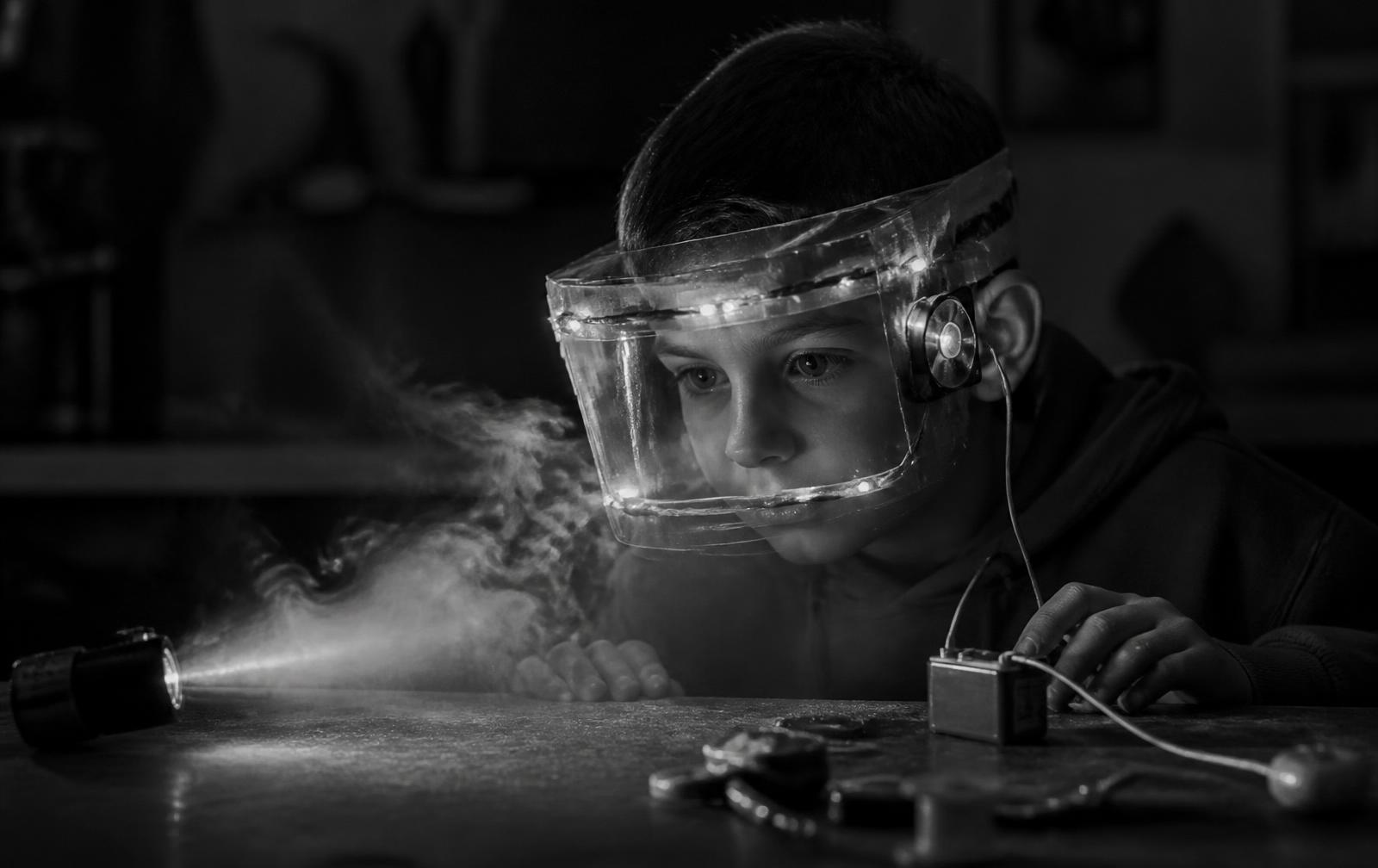
secureAIR is a wearable respiratory protection system with a transparent mouth-and-nose shield. Integrated micro-fans guide the breathing air through a compact UV-C LED unit, with the aim of inactivating viruses and bacteria directly in the air stream. The face stays visible, and breathing and speech are meant to stay as unhindered as possible.
Flat Rotor
The Flat Rotor works horizontally instead of high on a tower. It does not need to be turned into the wind, it produces far lower tilting and bending loads, and it can be deployed modularly on roofs, industrial sites, farmland or container platforms. Small prototypes are in trial operation.

Tube-Body Turbine
The tube-body turbine guides flowing water through a spiral, rotating tube body. Instead of braking the flow head-on, it uses the forces created by continuously deflecting the water mass. A larger prototype has been tested and measured in the river Elbe.