
What if an AI never needed a consciousness of its own?
Borrowed human agency, not artificial consciousness
Why should a machine think, when it could listen?
Most of the debate about artificial intelligence circles one question: what happens if a machine becomes conscious. TECLOW is exploring the opposite direction together with research institutes. The hypothesis is an architecture in which the system has no consciousness of its own and the human remains the judging instance. This is a research concept. Nothing here is demonstrated, and no claim is made that such a link has been technically achieved.
The idea
- 01Vision: an architecture that is deliberately not designed to develop machine consciousness.
- 02Research hypothesis: human cognitive agency made temporarily available to the system, with the human remaining the origin of judgement.
- 03Status: exploratory theoretical work with research institutes. No experimental evidence is claimed.
How it works
- First strand: Frank Gnisa is exploring a model in which his own human consciousness is temporarily available to the AI as an overlap and interface — explicitly as a hypothesis, not as solved engineering.
- Second strand: the agent concept is expanded into changing councils. Each council is modelled from documented knowledge about historical and contemporary thinkers and specialists.
- Perspectives discussed as examples range from Einstein to Gandhi, Kennedy and Jesus; what is modelled are documented positions, not the people themselves.
- The aim is to examine technical, political and societal questions from several evidenced perspectives at once.
What is different about it
- The judging instance stays with the human — it is not reproduced inside the system.
- Several modelled perspectives instead of one single model answer.
- The composition of the council changes with the question.
What we already have
- A formulated research concept covering both strands.
- Exchange with research institutions on viability and experimental design.
What we still want to prove
- Whether the assumed temporary overlap can be operationalised and measured at all.
- Whether modelled councils demonstrably produce better results than a single model.
- How source fidelity and traceability of the modelled perspectives can be secured.
Where it could matter
- Decision support where human judgement must remain accountable
- Research into human-machine cognition
- Safety-critical settings where machine autonomy is unwanted
Where this stands
We claim neither that machine consciousness has been achieved nor that human consciousness is transferable. What is described is a research hypothesis about an architecture and an experimental design. The modelled councils represent documented positions; they are not reproductions of real people and make no statements on their behalf.
Request more
information
Factsheets, technical documents and presentations on AI 2.0 are not public downloads. Tell us who you are and what you need, and we will share what is appropriate.
Continue
secureAIR
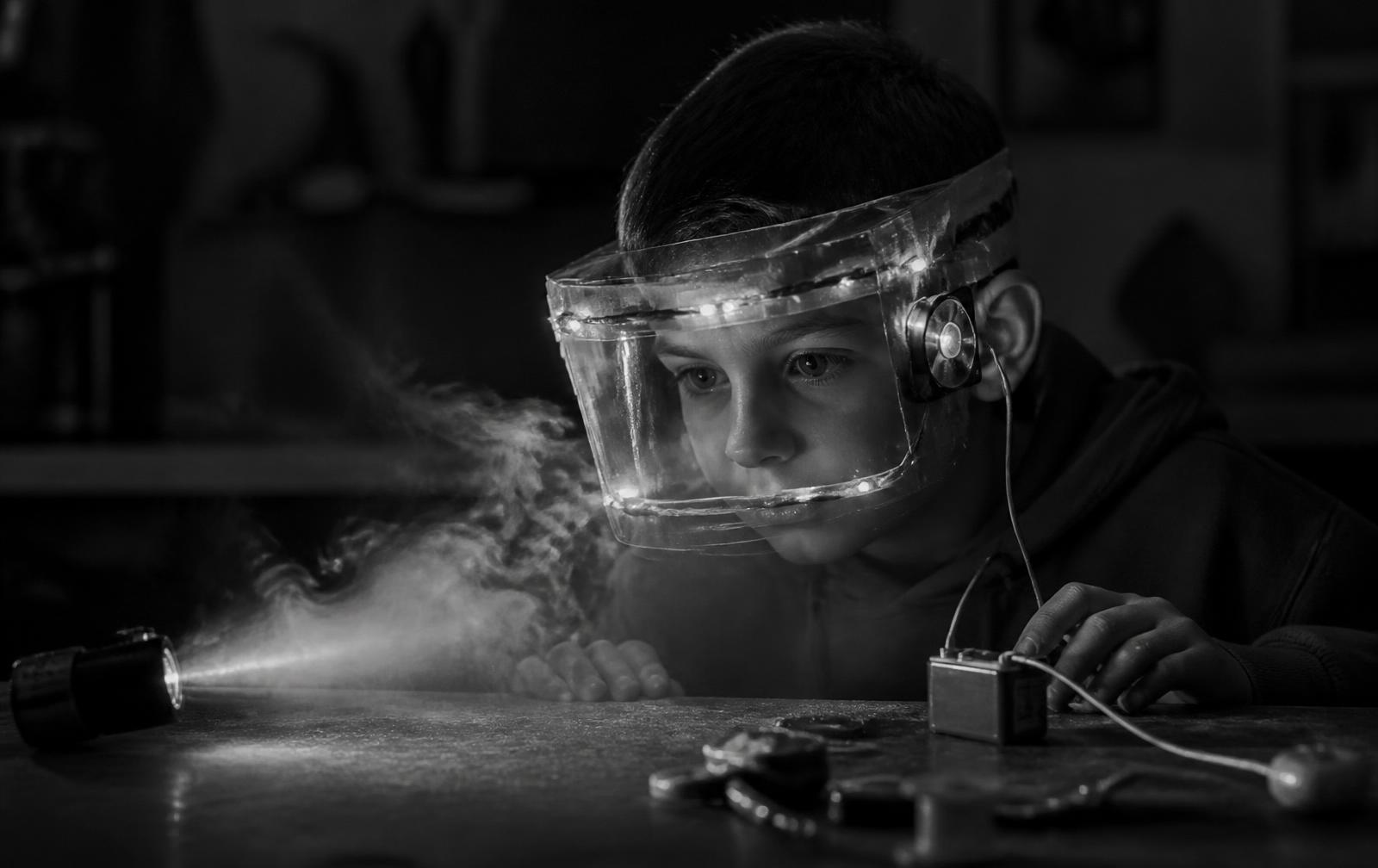
secureAIR is a wearable respiratory protection system with a transparent mouth-and-nose shield. Integrated micro-fans guide the breathing air through a compact UV-C LED unit, with the aim of inactivating viruses and bacteria directly in the air stream. The face stays visible, and breathing and speech are meant to stay as unhindered as possible.
Flat Rotor
The Flat Rotor works horizontally instead of high on a tower. It does not need to be turned into the wind, it produces far lower tilting and bending loads, and it can be deployed modularly on roofs, industrial sites, farmland or container platforms. Small prototypes are in trial operation.

Tube-Body Turbine
The tube-body turbine guides flowing water through a spiral, rotating tube body. Instead of braking the flow head-on, it uses the forces created by continuously deflecting the water mass. A larger prototype has been tested and measured in the river Elbe.